
NidetzkyLab (@nidetzkylab) 's Twitter Profile
NidetzkyLab

@nidetzkylab

Our lab @tugraz is focused on fundamental and applied Glycosciences and Glycobiotechnologies

ID: 1254677917772271616

linkhttps://www.tugraz.at/institutes/biote/home/ calendar_today27-04-2020 07:46:25

67 Tweet

223 Followers

102 Following

NidetzkyLab (@nidetzkylab) 's Twitter Profile Photo

Is the substrate for your glycosyltransferase poorly soluble in water and DMSO is inactivating your enzyme? Find out how you can use cyclodextrins to solve the problem in our newest publication: pubs.acs.org/doi/10.1021/ac… NidetzkyLab TU Graz

NidetzkyLab (@nidetzkylab) 's Twitter Profile Photo

🔍 Curious about the nuances between C- and O-glycoside elliminases? 🤔 Check our latest publication Springer Nature in Nature Communications from NidetzkyLab TU Graz nature.com/articles/s4146… #Enzymes #Biochemistry

NidetzkyLab (@nidetzkylab) 's Twitter Profile Photo

Curious about advanced sucrose phosphorylase kinetics? Explore our latest publications to delve into nuanced insights and understand how kinetic models elevate multi-enzyme cascades. TU Graz NidetzkyLab #Kinetics #EnzymeCascades onlinelibrary.wiley.com/doi/10.1002/bi… onlinelibrary.wiley.com/doi/10.1002/bi…

NidetzkyLab (@nidetzkylab) 's Twitter Profile Photo

"Dive into our new review on 'C-Ribosylating Enzymes in the (Bio)Synthesis of C-Nucleosides and Natural Products'! From antimicrobial compounds to mRNA vaccine building blocks, explore enzymes, mechanisms, and biocatalytic applications. ACS Catalysis pubs.acs.org/doi/10.1021/ac…


TU Graz (@tugraz) 's Twitter Profile Photo

Microorganisms in the human gut utilise so-called beta-elimination to break down plant natural products and thus make them available to humans. Fruit and vegetables contain a variety of plant natural products such as flavonoids, which are said to have health-promoting

NidetzkyLab (@nidetzkylab) 's Twitter Profile Photo

Ever considered using magnet-induced local heating to modulate enzyme activity? 🤔 Dive into our latest paper for insights and surprises: onlinelibrary.wiley.com/doi/10.1002/sm… #MagneticParticles @Tugraz

NidetzkyLab (@nidetzkylab) 's Twitter Profile Photo

Exploring Mechanochemical Coupling in Cellulose-Degrading Nanomachines! Our study unveils the cellulosome as a Brownian ratchet, propelling on cellulose by coupling protein motions to hydrolysis. Deeper insights: pubs.acs.org/doi/10.1021/ac…

NidetzkyLab (@nidetzkylab) 's Twitter Profile Photo

Our review titled” Bottom‐up Synthesized Glucan Materials: Opportunities from Applied Biocatalysis” is out! Discover how biocatalysis crafts precise D-glucan structures, paving the way for advanced material applications! onlinelibrary.wiley.com/doi/10.1002/ad…

NidetzkyLab (@nidetzkylab) 's Twitter Profile Photo

Flexible only to become rigid, no contradiction in enzyme catalysis! Our new study captures the interplay of structural preorganization and conformational sampling in UDP-glucuronic acid 4-epimerase catalysis. Nature Communications TU Graz nature.com/articles/s4146…

NidetzkyLab (@nidetzkylab) 's Twitter Profile Photo

Thrilled to share our latest work with colleagues from Innsbruck: An efficient synthetic route for accessing stable isotope labelled pseudouridine phosphoramidites, enabling precise RNA NMR spectroscopy. …mistry-europe.onlinelibrary.wiley.com/doi/10.1002/ch… TU Graz @uniinsbruck

Francesco Carraro (@carraro_fra) 's Twitter Profile Photo

Looking forward to share some of the research we are doing on magnetically responsive enzyme@HOF biocomposites: if you are interested, please join Session 2, today at 14:10! MOF2024 FalcaroGroup cdoonan NidetzkyLab DOI: 10.26434/chemrxiv-2024-p7159

Looking forward to share some of the research we are doing on magnetically responsive enzyme@HOF biocomposites: if you are interested, please join Session 2, today at 14:10!  <a href="/9thMOF2024/">MOF2024</a> <a href="/FalcaroG/">FalcaroGroup</a> <a href="/UAchemist/">cdoonan</a> <a href="/NidetzkyLab/">NidetzkyLab</a> DOI: 10.26434/chemrxiv-2024-p7159
NidetzkyLab (@nidetzkylab) 's Twitter Profile Photo

Excited to share our latest research on bacterial glucoside metabolism through a conserved non-hydrolytic pathway! TU Graz Angewandte Chemie NidetzkyLab #Microbiology #EnzymeResearch #Glucosides onlinelibrary.wiley.com/doi/10.1002/an…


Angewandte Chemie (@angew_chem) 's Twitter Profile Photo

Enzyme Machinery for Bacterial Glucoside Metabolism through a Conserved Non-hydrolytic Pathway (Bernd Nidetzky and co-workers). NidetzkyLab, TU Graz. #OpenAccess onlinelibrary.wiley.com/doi/10.1002/an…
NidetzkyLab (@nidetzkylab) 's Twitter Profile Photo

Electrochemically Induced Nanoscale Stirring Boosts Functional Immobilization of Flavocytochrome P450 BM3 on Nanoporous Gold Electrodes - Hengge - Small Methods - Wiley Online Library onlinelibrary.wiley.com/doi/10.1002/sm…

NidetzkyLab (@nidetzkylab) 's Twitter Profile Photo

Excited to share our latest research: Phosphorylation-condensation cascade for biocatalytic synthesis of C-nucleosides: Chem Catalysis cell.com/chem-catalysis…

NidetzkyLab (@nidetzkylab) 's Twitter Profile Photo

New paper out now in Angewandte Chemie! We present a chemoenzymatic route for synthesizing N¹-methylpseudouridine triphosphate — a key mRNA vaccine component. A step forward in efficient nucleotide synthesis. onlinelibrary.wiley.com/doi/10.1002/an… #RNA #mRNA #SynBio TU Graz

Biology+AI Daily (@biologyaidaily) 's Twitter Profile Photo

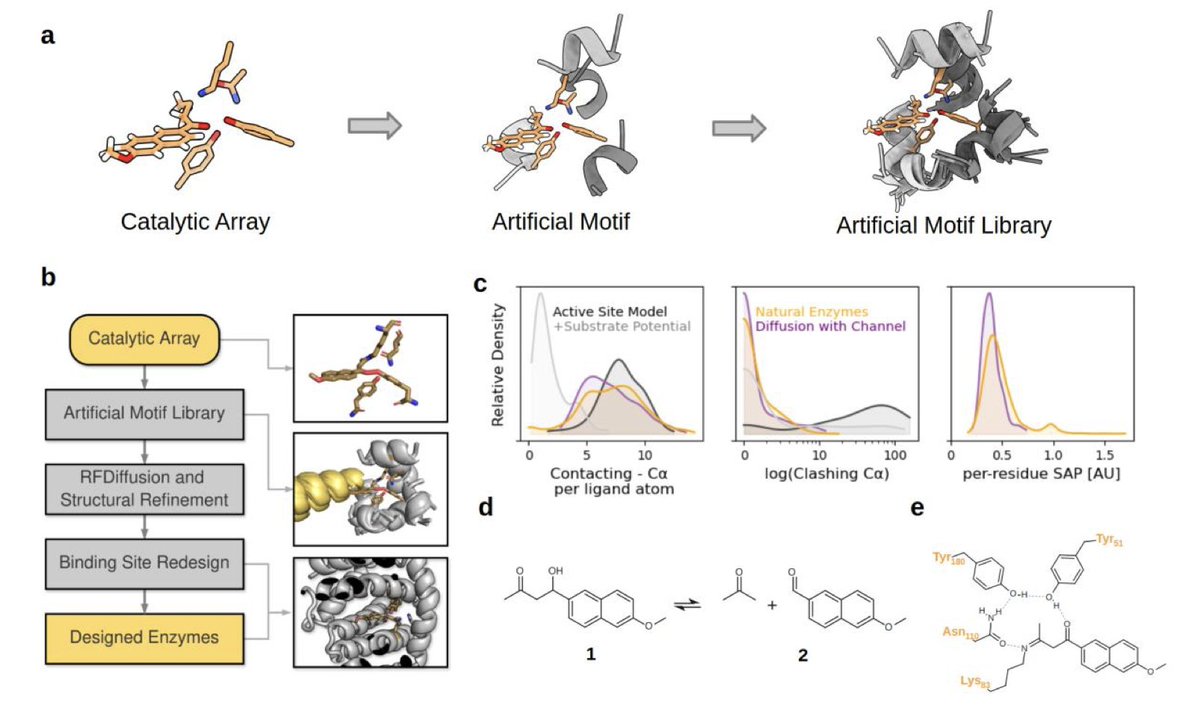
Computational enzyme design by catalytic motif scaffolding 1.A new enzyme design method called Riff-Diff combines machine learning with atomistic modeling to scaffold catalytic motifs in de novo proteins. It achieves catalytic activities approaching those of laboratory-evolved

Computational enzyme design by catalytic motif scaffolding

1.A new enzyme design method called Riff-Diff combines machine learning with atomistic modeling to scaffold catalytic motifs in de novo proteins. It achieves catalytic activities approaching those of laboratory-evolved
NidetzkyLab (@nidetzkylab) 's Twitter Profile Photo

Human GDP-l-fucose synthase (GFS) catalyzes a three-step reaction: epimerization at C-3″/C-5″ and NADPH-dependent reduction at C-4″. Kinetic and structural studies reveal: product release (GDP-l-fucose) is the rate-limiting step, not catalysis. pubs.acs.org/doi/10.1021/ac…