Paco Dardón (@pacodardon) 's Twitter Profile
Paco Dardón

@pacodardon

Internist & intensivist made @incmnszmx | Interested in critical care, hemodynamics, MV and #POCUS. Also fan of literature, music, films and life curiosities 🔍

ID: 1669230774

calendar_today14-08-2013 02:13:03

3,3K Tweet

1,1K Followers

1,1K Following
Curro Miralles (@curromir) 's Twitter Profile Photo

Can a patient be fluid responsive and venously congested at the same time? Yes — and this changes everything. Our recent study shows how bedside ultrasound can reveal what clinical signs often miss. Let’s break it down: #POCUS #VExUS #CriticalCare 🧵

CardiovascularCorner (@trackyourheart) 's Twitter Profile Photo

LV Torsion: A Powerful Marker of Systolic Function Definition Left ventricular (LV) torsion (or twist) refers to the wringing motion of the heart during systole, apical counterclockwise rotation vs basal clockwise rotation. It results from the unique helical arrangement of

LV Torsion: A Powerful Marker of Systolic Function

Definition 
Left ventricular (LV) torsion (or twist) refers to the wringing motion of the heart during systole, apical counterclockwise rotation vs basal clockwise rotation.
It results from the unique helical arrangement of
André Martin Mansoor (@andremansoor) 's Twitter Profile Photo

1/10 A 70-year-old man presents with dyspnea. What do you notice when you first meet him? This finding should generate a hypothesis, which we will circle back to eventually.

1/10
A 70-year-old man presents with dyspnea. What do you notice when you first meet him?

This finding should generate a hypothesis, which we will circle back to eventually.
Samuel Hume (@drsamuelbhume) 's Twitter Profile Photo

Top 5 advances in medicine this week (🧵) 1. A drug that beats chemotherapy in a subset of lung cancers Small cell lung cancer is usually treated with chemotherapy, but resistance is common, and side-effects can be severe Tarlatamab is a bispecific antibody: it recruits T

Top 5 advances in medicine this week (🧵)

1. A drug that beats chemotherapy in a subset of lung cancers

Small cell lung cancer is usually treated with chemotherapy, but resistance is common, and side-effects can be severe

Tarlatamab is a bispecific antibody: it recruits T
Samuel Hume (@drsamuelbhume) 's Twitter Profile Photo

This might be a simple way to (dramatically) improve outcomes in patients awaiting thrombectomy (mechanical clot removal) for ischaemic stroke in a large artery Put the head of the bed at 0°:

This might be a simple way to (dramatically) improve outcomes in patients awaiting thrombectomy (mechanical clot removal) for ischaemic stroke in a large artery

Put the head of the bed at 0°:
Ashley Miller (@icmteaching) 's Twitter Profile Photo

Important pushback on the Anderson/Guyton model: is pressure really a driver, or just a consequence of volume and compliance? A quick thread to unpack the physiology (and clinical relevance) 🧵👇

Ashley Miller (@icmteaching) 's Twitter Profile Photo

🧵 "What really determines tissue perfusion?" – and why most explanations get it wrong. Let’s sort out MAP, CVP, CCP, autoregulation, vasopressors, and the flow that actually reaches your organs. 👇

🧵 "What really determines tissue perfusion?"

– and why most explanations get it wrong.

Let’s sort out MAP, CVP, CCP, autoregulation, vasopressors, and the flow that actually reaches your organs.
👇
Paco Dardón (@pacodardon) 's Twitter Profile Photo

— So, your grampa's lungs are severely injured, we're not achieving our targets with the ventilator and it seems we'll have to connect him to an ECMO machine. – OMG, that sounds dangerous! Are there any other options? – Well...

Ashley Miller (@icmteaching) 's Twitter Profile Photo

1️⃣ We can remove fluid at rates up to 12 mL/kg/h and blood pressure often holds. That limit isn’t arbitrary – it comes from dialysis data showing steep rises in hypotension and mortality above it. It marks the upper boundary of how fast plasma can be refilled from the

C. Michael Gibson MD (@cmichaelgibson) 's Twitter Profile Photo

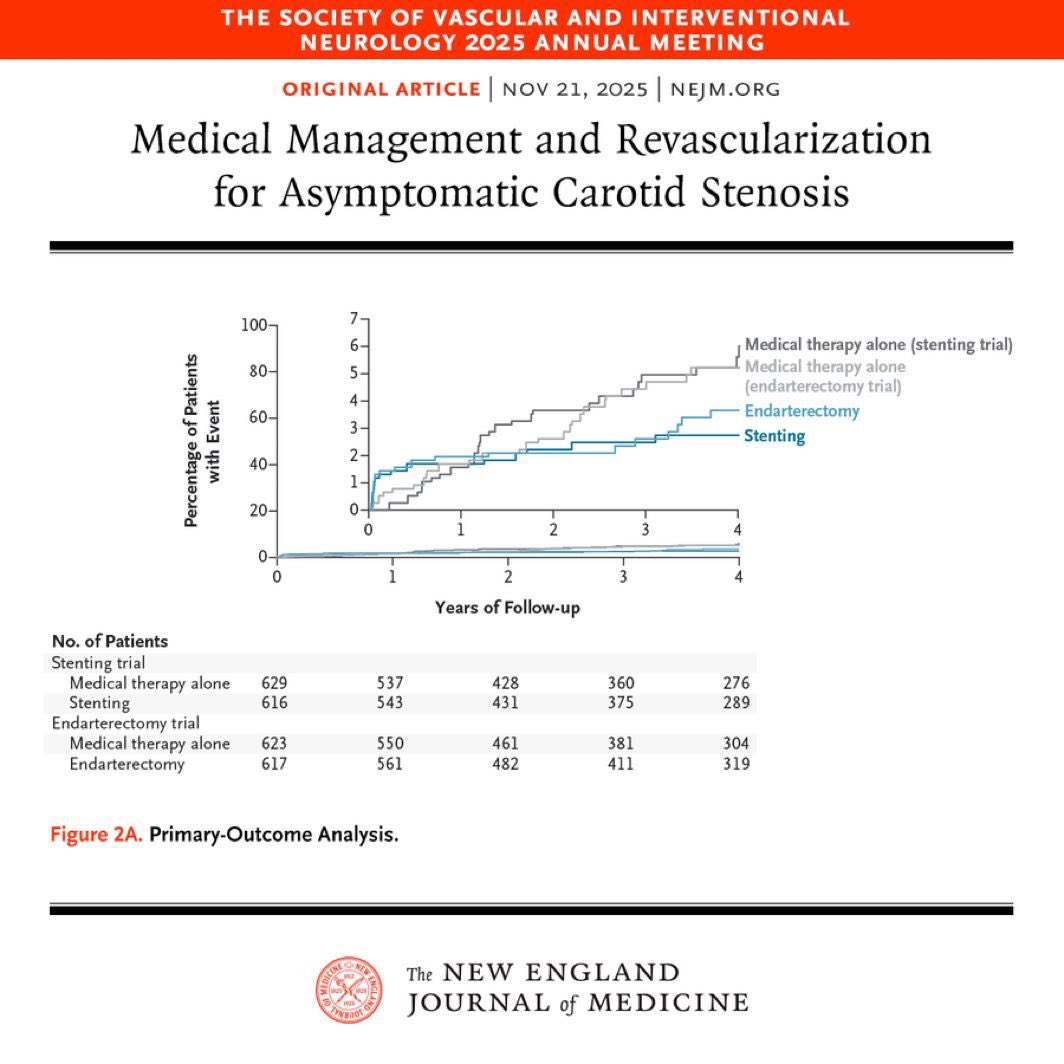
Among patients with high-grade stenosis without recent symptoms, the addition of stenting led to a lower risk of a composite of perioperative stroke or death or ipsilateral stroke within 4 years than intensive medical management alone. Carotid endarterectomy did not lead to a

Among patients with high-grade stenosis without recent symptoms, the addition of stenting led to a lower risk of a composite of perioperative stroke or death or ipsilateral stroke within 4 years than intensive medical management alone. Carotid endarterectomy did not lead to a