Ancestral Whispers (@sulkalmakh) 's Twitter Profile
Ancestral Whispers

@sulkalmakh

Facial reconstructions, Anthropology, Archaeogenetics, Archaeology, Ethnography.

ID: 1244265966122545152

linkhttps://www.ancestralwhispers.org/ calendar_today29-03-2020 14:12:57

1,1K Tweet

19,19K Followers

28 Following
InterspeciesFace (@interspeciesfa1) 's Twitter Profile Photo

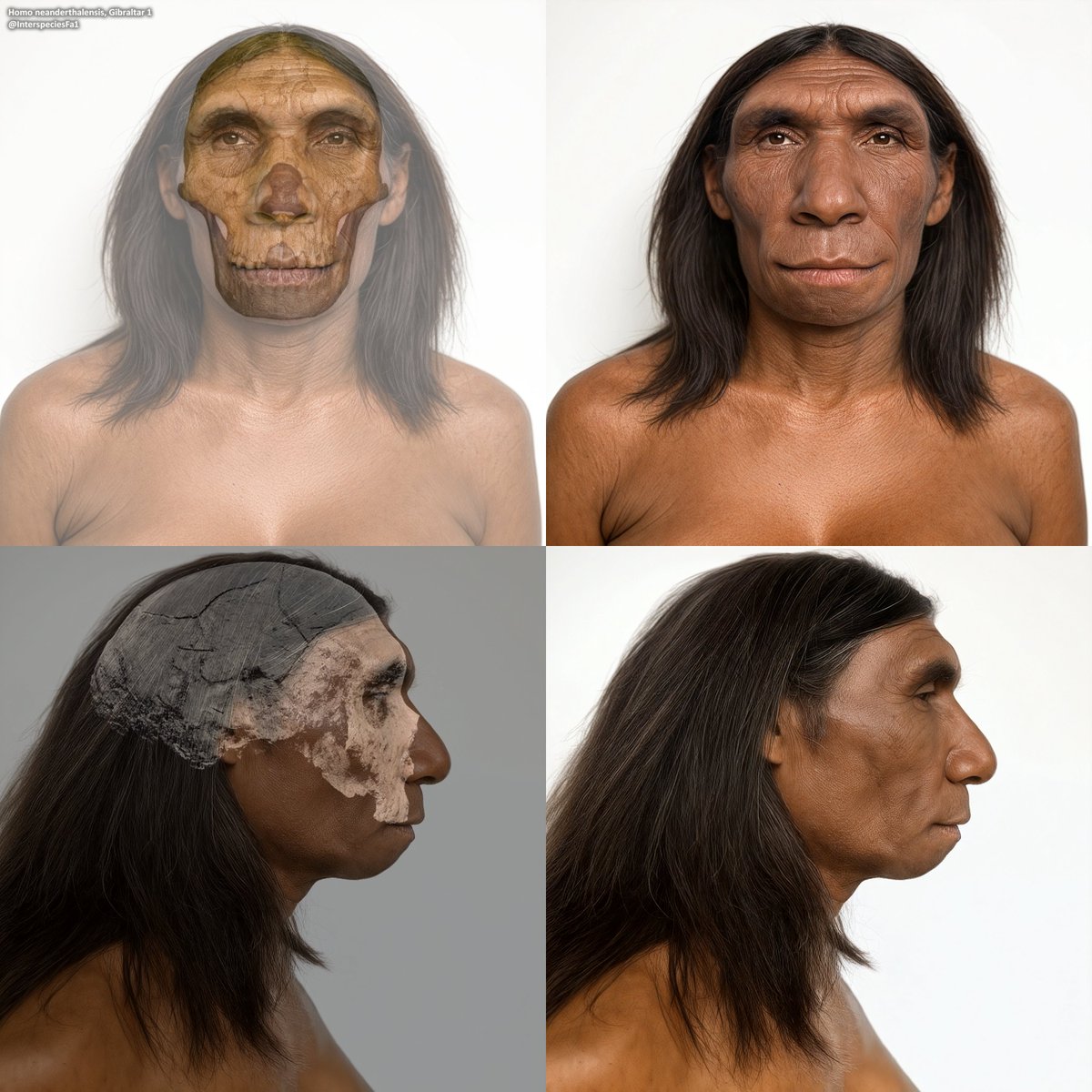
Quality update for my representation of Gibraltar 1, a Neanderthal woman, including improved texture and depth, adjustments to body proportions, and a profile view.

Quality update for my representation of Gibraltar 1, a Neanderthal woman, including improved texture and depth, adjustments to body proportions, and a profile view.
InterspeciesFace (@interspeciesfa1) 's Twitter Profile Photo

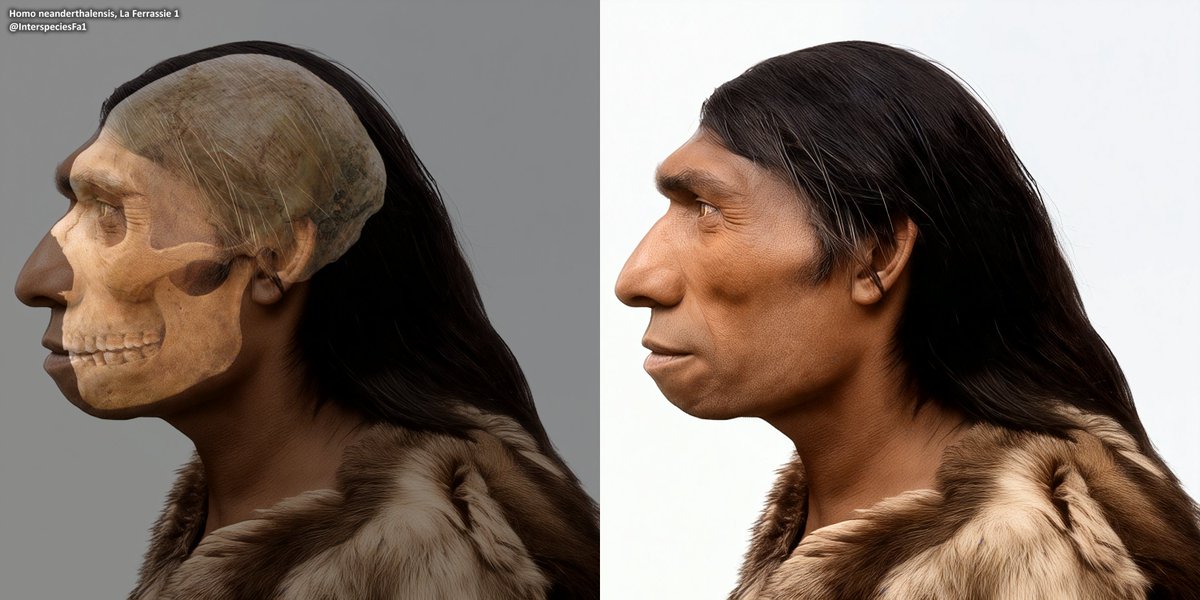
Quality update for my representation of La Ferrassie 1, a Neanderthal man, with fairly minor adjustments, slight refinement of texture, and an accompanying profile view. The soft tissue of this look was more inspired by modern populations, such as Fuegians, rather than apes.

Quality update for my representation of La Ferrassie 1, a Neanderthal man, with fairly minor adjustments, slight refinement of texture, and an accompanying profile view.
The soft tissue of this look was more inspired by modern populations, such as Fuegians, rather than apes.
Ari (@adarhoshang) 's Twitter Profile Photo

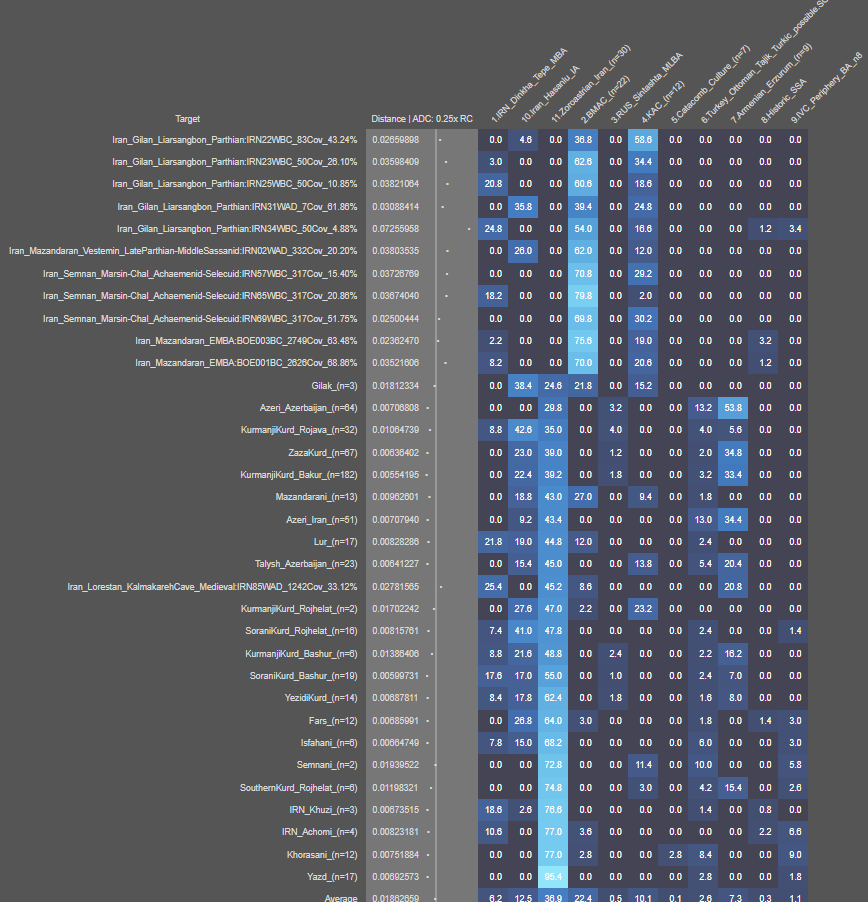
The following is an appropriate G25 model for samples as presented by Amjadi et al., contrasted against modern West Iranian-derived populations and two additional Bronze Age samples from Mazandaran. All the samples from this study, except for a medieval-era Luristan sample and

The following is an appropriate G25 model for samples as presented by Amjadi et al., contrasted against modern West Iranian-derived populations and two additional Bronze Age samples from Mazandaran. All the samples from this study, except for a medieval-era Luristan sample and
Pax Weltkrieg (@vveltkrieger) 's Twitter Profile Photo

ORIGINS OF THE DACIANS AND THRACIANS 🧵 This thread will trace the origins of the Dacian and Thracian people, from the Iron Age through the entire Bronze Age, relying primarily on archaeology supplemented and backed with genetic evidence. I believe it is possible to definitively

ORIGINS OF THE DACIANS AND THRACIANS 🧵

This thread will trace the origins of the Dacian and Thracian people, from the Iron Age through the entire Bronze Age, relying primarily on archaeology supplemented and backed with genetic evidence. I believe it is possible to definitively
Ancestral Whispers (@sulkalmakh) 's Twitter Profile Photo

Facial reconstruction of an Aryan man from the Indo-Iranic Srubnaya culture. Found in Utvinka, Northwest Kazakhstan. He died from two blunt-force head injuries. His skull was of average size: 189mm in length, 137mm in width, and 131mm in facial width.

Ancestral Whispers (@sulkalmakh) 's Twitter Profile Photo

Facial reconstruction of a Norwegian man from Heidal, dated to the 11th–13th centuries. The individual had a large facial breadth of 138 mm, a medium-large cranial length of 186 mm, and a medium-low cranial width of 137 mm.

Ancestral Whispers (@sulkalmakh) 's Twitter Profile Photo

Facial reconstruction of Combe Capelle, a 9,500-year-old WHG from France. Standing at 160 cm tall, he displayed several undifferentiated Cro-Magnon features. His cranial length was very large - 202mm, his cranial width was small - 134mm, and his facial width was large - 137mm.

Ancestral Whispers (@sulkalmakh) 's Twitter Profile Photo

Facial reconstruction of a 9,000-year-old WHG from Germany. Standing 165cm tall, she likely died of tooth inflammation at 30–40 years old. Buried with an unrelated infant in a rich Mesolithic grave, people continued to bring offerings to her grave for centuries after her death.

Ancestral Whispers (@sulkalmakh) 's Twitter Profile Photo

Facial reconstruction of an early Neolithic forager from the Vasilievka 2 burial in Ukraine. The culture, with its likely roots in the Middle Danube, was characterized by robusticity. This man’s dry bone facial breadth was 165mm—almost 4cm wider than the modern European average.

InterspeciesFace (@interspeciesfa1) 's Twitter Profile Photo

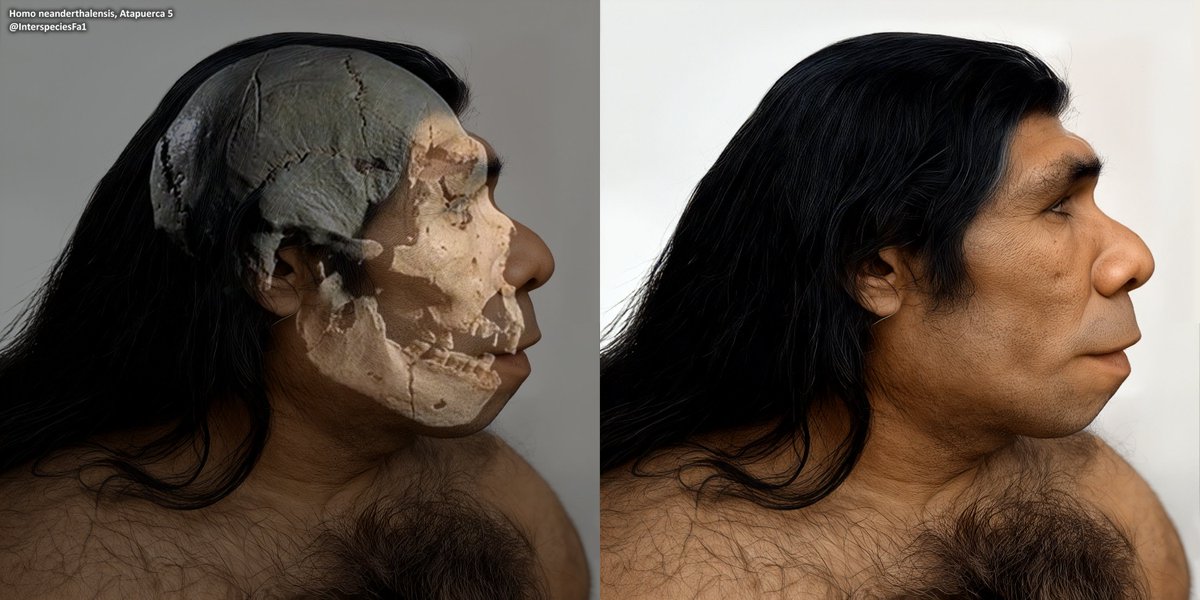
Facial Approximation based on Atapuerca 5, a Homo heidelbergensis, or primitive neanderthal, man from Sima de los Huesos, in the province of Burgos, Spain, dated to approximately 350k-500kya.

Facial Approximation based on Atapuerca 5, a Homo heidelbergensis, or primitive neanderthal, man from Sima de los Huesos, in the province of Burgos, Spain, dated to approximately 350k-500kya.
Ari (@adarhoshang) 's Twitter Profile Photo

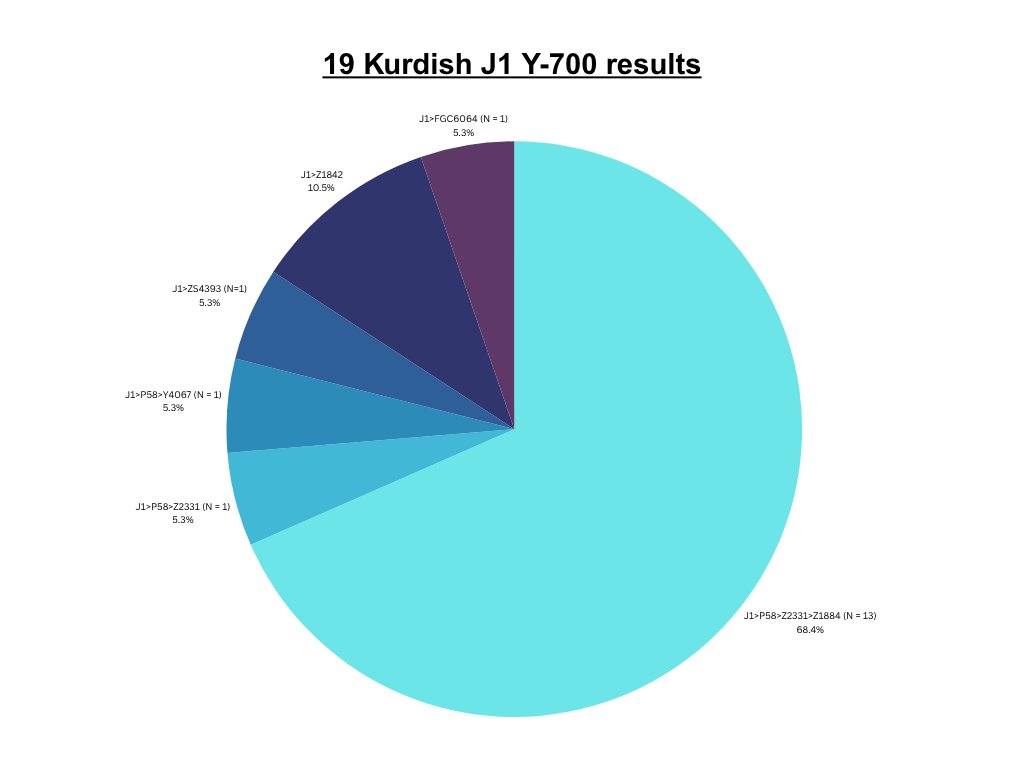
In the following, I will present the origins of all fully sequenced Y-700 Kurdish J1 samples we currently have in our dataset. To preface this analysis, out of a total of 274 Kurdish Y-700 samples, 19 belong to haplogroup J1, representing approximately 6.9% of the total. To

In the following, I will present the origins of all fully sequenced Y-700 Kurdish J1 samples we currently have in our dataset. To preface this analysis, out of a total of 274 Kurdish Y-700 samples, 19 belong to haplogroup J1, representing approximately 6.9% of the total. To
Ancestral Whispers (@sulkalmakh) 's Twitter Profile Photo

Facial Reconstruction of a 2,500-Year-Old Scythian woman from Dogehe-Baary II, Tuva. On average, the female individuals at the burial had a cranial length of 180 mm, cranial width of 140 mm, and a cheek breadth of 125 mm.

Ancestral Whispers (@sulkalmakh) 's Twitter Profile Photo

Facial reconstruction of an LBA Karasuk man from Minusinsk, Siberia. The Iranic Karasuk culture was one of the primary genetic contributors to what would later become the Scythians. Their skulls were robust, averaging 183 mm in length, 147 mm in width, and 140 mm in cheek width.

Ancestral Whispers (@sulkalmakh) 's Twitter Profile Photo

Facial reconstruction of a 10,000-year-old EHG from Sidelkino, Samara. She belonged to the "Ancient Uraloid" type, defined by Viktor Bunak as a group with both West and East Eurasian features, yet developed independently of either.

Ancestral Whispers (@sulkalmakh) 's Twitter Profile Photo

Facial reconstruction of a man buried in a catacomb burial in Duba-Yurt, Chechnya, dated to the Alan-Khazar period. The man had a medium-large cranial length of 187 mm, a narrow cranial width of 131 mm, and a medium cheekbone width of 131 mm.