

Wenxin Hu (@wenxinhu2) 's Twitter Profile
Wenxin Hu

@wenxinhu2

Postdoc at UNC Chapel Hill, Environmental health, Toxicology

ID: 1254970429829255168

calendar_today28-04-2020 03:07:35

32 Tweet

73 Followers

248 Following

Dr. Li Li (@modelerli) 's Twitter Profile Photo

Super excited and proud to be a part of this fantastic #Nature publication underscoring the importance of considering atmospherically transformed products in the global risk management of commercial chemicals

Beate Ritz, MD,PhD (@beate_ritz) 's Twitter Profile Photo

Check this out: exciting work by Kim, Richard and Edison! Coupling comprehensive pesticide-wide association study to iPSC dopaminergic screening identifies and classifies Parkinson-relevant pesticides biorxiv.org/content/10.110…

Department of Environmental Science at Sthlm Uni (@acessthlmuni) 's Twitter Profile Photo

New #study published in Science Magazine shows that exposure to #chemical cocktails in early #pregnancy is linked to #LANGUAGE delays in children. Managing each chemical in isolation is ineffective. It's time to introduce mixture #risk assessments. bit.ly/3gUoecR

Environmental Health Perspectives (@ehponline) 's Twitter Profile Photo

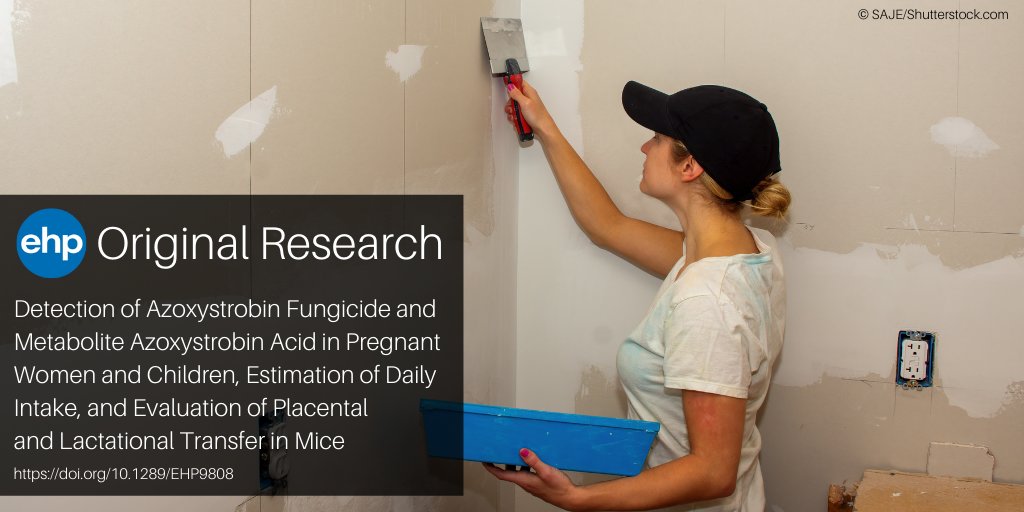
NEW: Commonly used in agriculture, the neurotoxic #fungicide azoxystrobin is also used increasingly in mold- and mildew-resistant wallboard. Hu et al. assess what exposure via this source might mean for #pregnant women and #children ➡️ ehp.niehs.nih.gov/EHP9808

NEW: Commonly used in agriculture, the neurotoxic #fungicide azoxystrobin is also used increasingly in mold- and mildew-resistant wallboard. Hu et al. assess what exposure via this source might mean for #pregnant women and #children ➡️ ehp.niehs.nih.gov/EHP9808
Environmental Health Perspectives (@ehponline) 's Twitter Profile Photo

NEW RESEARCH: Detection of Azoxystrobin Fungicide and Metabolite Azoxystrobin Acid in Pregnant Women and Children, Estimation of Daily Intake, and Evaluation of Placental and Lactational Transfer in Mice. Read the article ➡️ ow.ly/HQgL50I3wqe The University of North Carolina at Chapel Hill Wenxin Hu Mark Zylka

Environmental Health Perspectives (@ehponline) 's Twitter Profile Photo

MOST READ RESEARCH this week: Detection of Azoxystrobin Fungicide and Metabolite Azoxystrobin-Acid in Pregnant Women and Children, Estimation of Daily Intake, and Evaluation of Placental and Lactational Transfer in Mice ➡️ ow.ly/tUjG50Iajh1 The University of North Carolina Wenxin Hu Mark Zylka

Environmental Health Perspectives (@ehponline) 's Twitter Profile Photo

NEW: Experimental evidence indicates azoxystrobin is toxic to the developing embryo, but little is known about the routes and extent of people’s exposure to this fungicide. Hu et al. set out to find some answers. Read our summary ➡️ ehp.niehs.nih.gov/doi/10.1289/EH…

NEW: Experimental evidence indicates azoxystrobin is toxic to the developing embryo, but little is known about the routes and extent of people’s exposure to this fungicide. Hu et al. set out to find some answers. Read our summary ➡️ ehp.niehs.nih.gov/doi/10.1289/EH…
Nil Aygun (@nilaygun8) 's Twitter Profile Photo

Happy to share our recent work from Jason Stein and Michael Love where we identified causal cell-type-specific gene regulatory pathways using mediation analysis during human cortical development biorxiv.org/content/10.110…

Wenxin Hu (@wenxinhu2) 's Twitter Profile Photo

New EHP paper from my PhD lab. We used human trophoblast organoid model to screen flame retardants that affect placentation. Big congrats to Xu et al.

Science Magazine (@sciencemagazine) 's Twitter Profile Photo

Coral reefs face many serious threats from human activity. Experiments in sea anemone and mushroom coral now show that the sunscreen component oxybenzone can be converted to a powerful phototoxin in their cells. Read that study and more in Science: fcld.ly/zhyfd6a

Coral reefs face many serious threats from human activity. 

Experiments in sea anemone and mushroom coral now show that the sunscreen component oxybenzone can be converted to a powerful phototoxin in their cells. Read that study and more in Science: fcld.ly/zhyfd6a
Wenxin Hu (@wenxinhu2) 's Twitter Profile Photo

Nice article about our recent EHP paper. We detected azoxystrobin and its metabolite from children urine samples, found AZ exposure is common in human. We also found this chemical could be transferred from exposed pregnant mice to their fetus cortex, posing a neurotoxicity.

UNC School of Medicine (@unc_som) 's Twitter Profile Photo

Scientists The University of North Carolina at Chapel Hill Detect Common Fungicide in Pregnant Women & Children: unchealth.info/nGra50J5x1F Mark Zylka lab found maternal transfer of #azoxystrobin to mouse embryos & weaning-age mice; calls for further research on effects of chronic exposure. @UNCResearch Live Science Scientific American

Scientists <a href="/UNC/">The University of North Carolina at Chapel Hill</a> Detect Common Fungicide in Pregnant Women &amp; Children: unchealth.info/nGra50J5x1F
<a href="/MarkZylka/">Mark Zylka</a> lab found maternal transfer of #azoxystrobin to mouse embryos &amp; weaning-age mice; calls for further research on effects of chronic exposure.
@UNCResearch <a href="/LiveScience/">Live Science</a> <a href="/sciam/">Scientific American</a>
Environmental Health Perspectives (@ehponline) 's Twitter Profile Photo

NEW: Adverse #pregnancy outcomes occur worldwide at concerning rates. Xu et al. used a novel in vitro model to study how #chemicalexposures may contribute to these outcomes by disrupting placental formation. Read our summary ➡️ ow.ly/x6KI50JlZY5 Peking University


NEW: Adverse #pregnancy outcomes occur worldwide at concerning rates. Xu et al. used a novel in vitro model to study how #chemicalexposures may contribute to these outcomes by disrupting placental formation. Read our summary ➡️ ow.ly/x6KI50JlZY5 <a href="/PKU1898/">Peking University</a>
Peng Gao (@penggaos) 's Twitter Profile Photo

So thrilled our exposome paper is finally online! Please share this with anyone interested in the associations between abiotic/biotic exposures and human biomolecules. Hope it can be a valuable resource for future exposome-phenome interactions studies! genome.cshlp.org/cgi/content/lo…

Nina Zhao (@ninahaoqizhao) 's Twitter Profile Photo

From a reunion during #SETAC #NonTarget2022, a really fun collaboration bloomed! Maternal exposure to 6PPD and 6PPDQ transfers to the brain of unborn mice fetus. Plus, 6PPDQ acts as a strong agonist towards RARα and RXRα pathways! pubs.acs.org/doi/10.1021/ac…

Mark Zylka (@markzylka) 's Twitter Profile Photo

Studying environmental risks is hard. Typically need to test one chemical at a time, and if no effects seen, massive waste of effort. Inspired by genetic screens, Wenxin Hu in our lab found chemicals that impact brain development in a more effecient manner. Led us to PFOA.