
Katherine Hermann (@khermann_) 's Twitter Profile
Katherine Hermann

@khermann_

Research Scientist @GoogleDeepMind | Past: PhD from @Stanford

ID: 760986968855425025

calendar_today03-08-2016 23:53:26

373 Tweet

1,1K Followers

1,1K Following

Google DeepMind (@googledeepmind) 's Twitter Profile Photo

On the latest episode of our podcast, research lead Irina and host @fryrsquared discuss the exciting potential of AI tutors – like our LearnLM Learning Coach on YouTube – to personalize learning and support teachers. 🧠 Watch the full episode now ↓ Timestamps: 00:06 Intro

Thomas Fel (@napoolar) 's Twitter Profile Photo

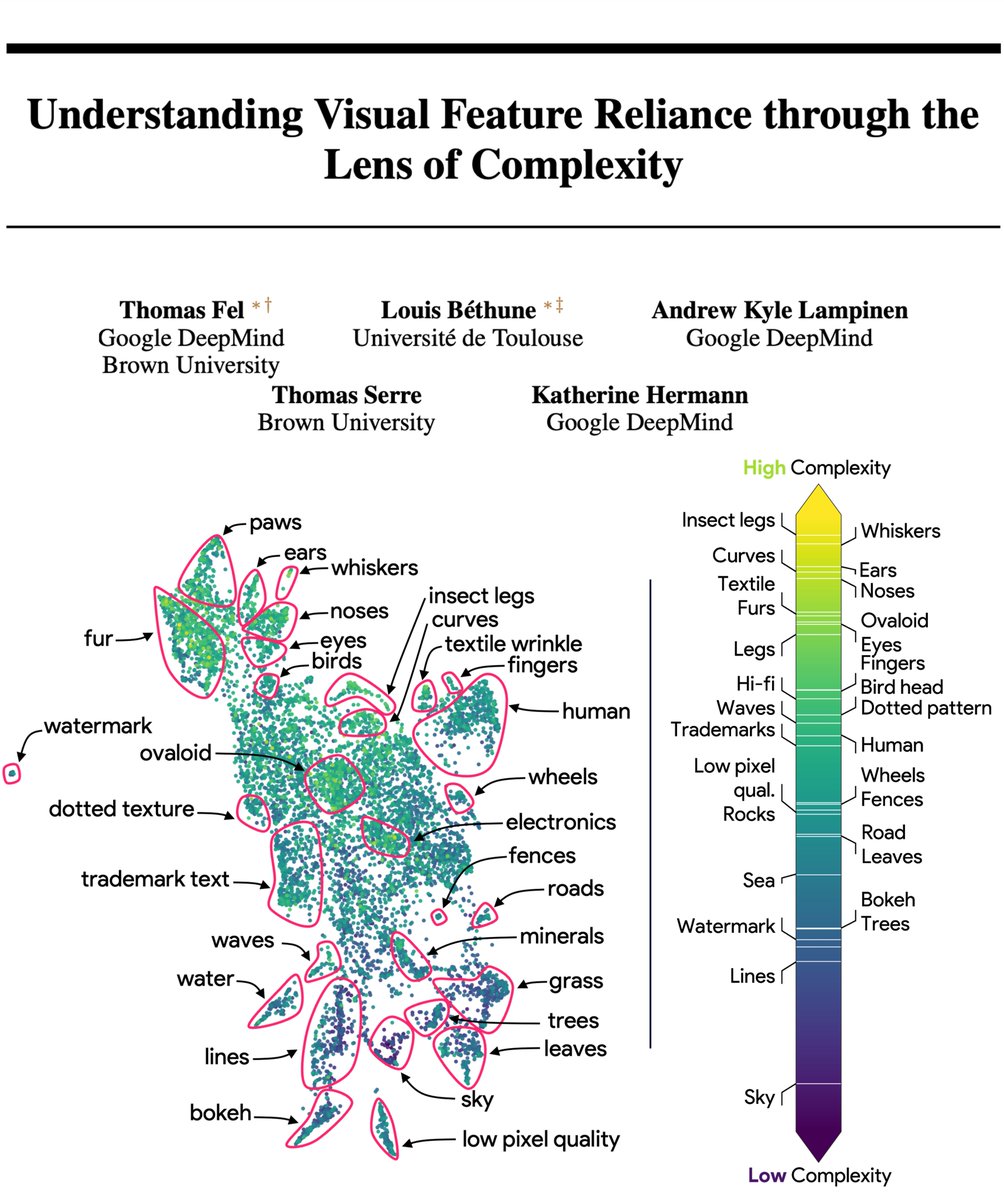
🎭Recent work shows that models’ inductive biases for 'simpler' features may lead to shortcut learning. What do 'simple' vs 'complex' features look like? What roles do they play in generalization? Our new paper explores these questions. arxiv.org/pdf/2407.06076 #Neurips2024

🎭Recent work shows that models’ inductive biases for 'simpler' features may lead to shortcut learning. 

What do 'simple' vs 'complex' features look like? What roles do they play in generalization?

Our new paper explores these questions. 
arxiv.org/pdf/2407.06076

#Neurips2024
Thomas Fel (@napoolar) 's Twitter Profile Photo

Don't hesitate to check our previous work: arxiv.org/abs/2310.16228 And I highly recommend checking out this excellent related work by Andrew, Stephanie Chan and Katherine: arxiv.org/pdf/2405.05847.

Andrew Lampinen (@andrewlampinen) 's Twitter Profile Photo

Check out Thomas's cool exploration of how features emerge over layers and over training in a vision model, and how they contribute to the model's outputs!

Sjoerd van Steenkiste (@vansteenkiste_s) 's Twitter Profile Photo

Excited to announce MooG for learning video representations. MooG allows tokens to move “off-the-grid” enabling better representation of scene elements, even as they move across the image plane through time. 📜arxiv.org/abs/2411.05927 🌐moog-paper.github.io

Excited to announce MooG for learning video representations. MooG allows tokens to move “off-the-grid” enabling better representation of scene elements, even as they move across the image plane through time.

📜arxiv.org/abs/2411.05927
🌐moog-paper.github.io
Jennifer Hu (@_jennhu) 's Twitter Profile Photo

Stop by our #NeurIPS tutorial on Experimental Design & Analysis for AI Researchers! 📊 neurips.cc/virtual/2024/t… Are you an AI researcher interested in comparing models/methods? Then your conclusions rely on well-designed experiments. We'll cover best practices + case studies. 👇

Stephanie Chan (@scychan_brains) 's Twitter Profile Photo

Devastatingly, we have lost a bright light in our field. Felix Hill was not only a deeply insightful thinker -- he was also a generous, thoughtful mentor to many researchers. He majorly changed my life, and I can't express how much I owe to him. Even now, Felix still has so much

Andrew Lampinen (@andrewlampinen) 's Twitter Profile Photo

New (short) paper investigating how the in-context inductive biases of vision-language models — the way that they generalize concepts learned in context — depend on the modality and phrasing! 1/4

New (short) paper investigating how the in-context inductive biases of vision-language models — the way that they generalize concepts learned in context — depend on the modality and phrasing! 1/4
Aran Nayebi (@aran_nayebi) 's Twitter Profile Photo

Are there fundamental barriers to AI alignment once we develop generally-capable AI agents? We mathematically prove the answer is *yes*, and outline key properties for a "safe yet capable" agent. 🧵👇 Paper: arxiv.org/abs/2502.05934

Are there fundamental barriers to AI alignment once we develop generally-capable AI agents?

We mathematically prove the answer is *yes*, and outline key properties for a "safe yet capable" agent. 🧵👇

Paper: arxiv.org/abs/2502.05934
Aran Nayebi (@aran_nayebi) 's Twitter Profile Photo

1/ 🧵👇 What should count as a good model of intelligence? AI is advancing rapidly, but how do we know if it captures intelligence in a scientifically meaningful way? We propose the *NeuroAI Turing Test*—a benchmark that evaluates models based on both behavior and internal

1/ 🧵👇
What should count as a good model of intelligence?

AI is advancing rapidly, but how do we know if it captures intelligence in a scientifically meaningful way?

We propose the *NeuroAI Turing Test*—a benchmark that evaluates models based on both behavior and internal
Aran Nayebi (@aran_nayebi) 's Twitter Profile Photo

Had a lot of fun speaking with Eddie Avil about the practical challenges of scaling (especially in Embodied AI), NeuroAI, what to expect in the future, and advice for students getting into the field. Check it out here! youtube.com/watch?v=ZRo-fL…


Thomas Fel (@napoolar) 's Twitter Profile Photo

Train your vision SAE on Monday, then again on Tuesday, and you'll find only about 30% of the learned concepts match. ⚓ We propose Archetypal SAE which anchors concepts in the real data’s convex hull, delivering stable and consistent dictionaries. arxiv.org/pdf/2502.12892…

Train your vision SAE on Monday, then again on Tuesday, and you'll find only about 30% of the learned concepts match.

⚓ We propose Archetypal SAE  which anchors concepts in the real data’s convex hull, delivering stable and consistent dictionaries.

arxiv.org/pdf/2502.12892…
Kelsey Allen (@kelseyrallen) 's Twitter Profile Photo

Humans can tell the difference between a realistic generated video and an unrealistic one – can models? Excited to share TRAJAN: the world’s first point TRAJectory AutoeNcoder for evaluating motion realism in generated and corrupted videos. 🌐 trajan-paper.github.io 🧵

Andrew Lampinen (@andrewlampinen) 's Twitter Profile Photo

How do language models generalize from information they learn in-context vs. via finetuning? We show that in-context learning can generalize more flexibly, illustrating key differences in the inductive biases of these modes of learning — and ways to improve finetuning. Thread: 1/

How do language models generalize from information they learn in-context vs. via finetuning? We show that in-context learning can generalize more flexibly, illustrating key differences in the inductive biases of these modes of learning — and ways to improve finetuning. Thread: 1/
Aran Nayebi (@aran_nayebi) 's Twitter Profile Photo

Our first NeuroAgent! 🐟🧠 Excited to share new work led by the talented Reece Keller, showing how autonomous behavior and whole-brain dynamics emerge naturally from intrinsic curiosity grounded in world models and memory. Some highlights: - Developed a novel intrinsic drive

Aran Nayebi (@aran_nayebi) 's Twitter Profile Photo

🚀 New Open-Source Release! PyTorchTNN 🚀 A PyTorch package for building biologically-plausible temporal neural networks (TNNs)—unrolling neural network computation layer-by-layer through time, inspired by cortical processing. PyTorchTNN naturally integrates into the

Andrew Lampinen (@andrewlampinen) 's Twitter Profile Photo

In neuroscience, we often try to understand systems by analyzing their representations — using tools like regression or RSA. But are these analyses biased towards discovering a subset of what a system represents? If you're interested, check out our new commentary! Thread:

In neuroscience, we often try to understand systems by analyzing their representations — using tools like regression or RSA. But are these analyses biased towards discovering a subset of what a system represents? If you're interested, check out our new commentary! Thread:
Andrew Lampinen (@andrewlampinen) 's Twitter Profile Photo

Many representational analyses (implicitly) prioritize signals by the amount of variance they explain in the representations. However, in arxiv.org/abs/2507.22216 we discuss results from our prior work that challenge this assumption; variance != computational importance.