

William Hayes (@wmhayes_psyc) 's Twitter Profile
William Hayes

@wmhayes_psyc

Assistant Prof @Binghamtonu. | DReaM Lab | Decision Research and Modeling

ID: 1545886956269223937

calendar_today09-07-2022 21:46:14

67 Tweet

113 Followers

119 Following

Sebastian Olschewski (@seb_olschewski) 's Twitter Profile Photo

New publication PNASNews: Frequent winners explain apparent skewness preferences in experience-based decisions pnas.org/doi/epdf/10.10… With Mikhail Spektor and Gael Le Mens Thread(1/7)>>>

Zhu Jian-Qiao (@jq_zhu) 's Twitter Profile Photo

Large language models show promise as cognitive models. The behaviors they produce often mirror human behaviors, suggesting we might gain insight into human cognition by studying LLMs. But why do LLMs behave like humans at all?🤔🧵arxiv.org/abs/2405.19313

William Hayes (@wmhayes_psyc) 's Twitter Profile Photo

Update to our paper on presentation format and context effects in choice: We added a second experiment showing that the *commensurability* of attributes is critical: attraction and compromise effects disappear when attribute values are on the same scale. osf.io/preprints/psya…

William Hayes (@wmhayes_psyc) 's Twitter Profile Photo

In prepping to teach graduate-level stats this fall, I have finally discovered the beauty of LaTeX for presentations. I may never open PowerPoint again.

William Hayes (@wmhayes_psyc) 's Twitter Profile Photo

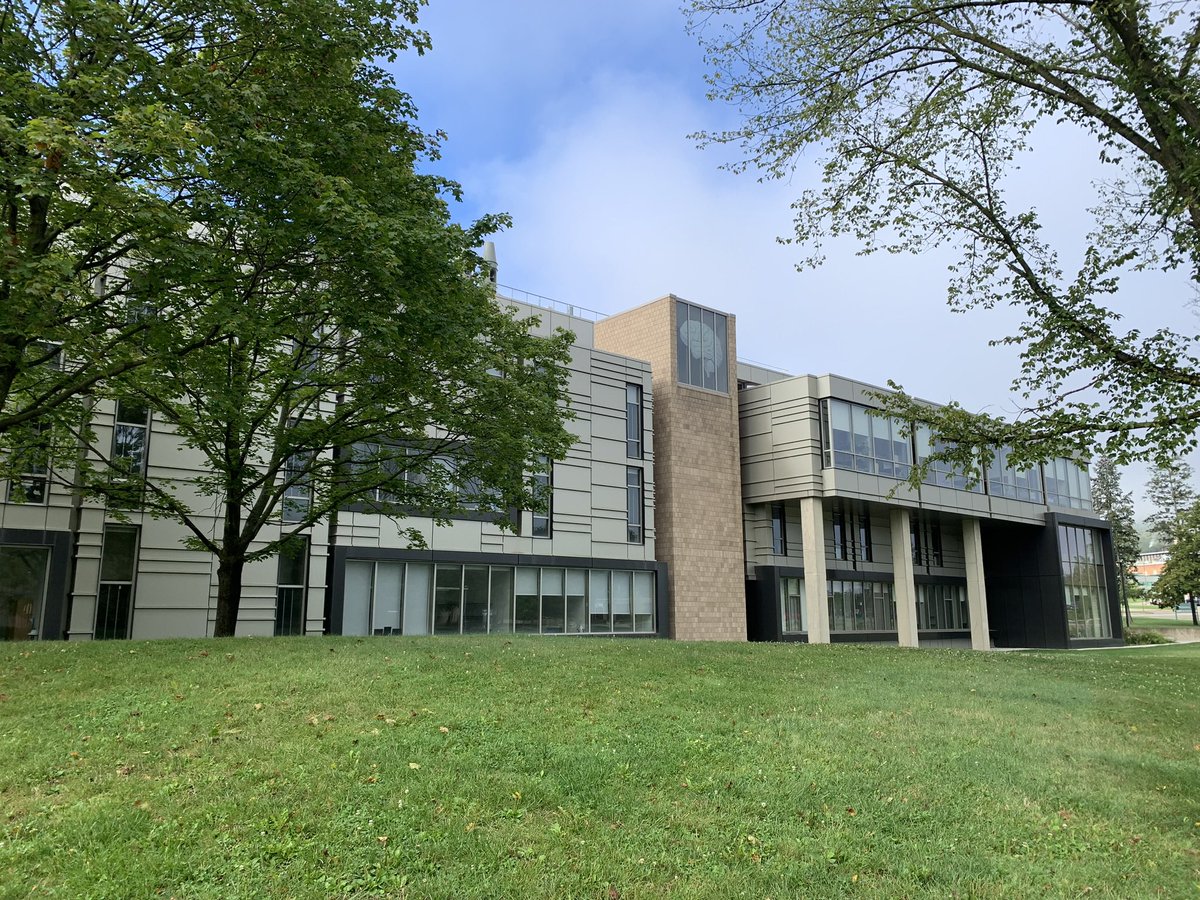
This summer, I had the pleasure of mentoring 3 computer science majors and 1 psychology major on research at the intersection of artificial intelligence and cognitive science. Thanks to the Binghamton University⁩ BUPNUR program for making this possible! binghamton.edu/news/story/505…
Stefano Palminteri (@stepalminteri.bsky.social) (@stepalminteri) 's Twitter Profile Photo

New preprint out! Context induces distortions in value representations: a test across multiple elicitation methods and learning modalities, where we significantly extend our understanding of context effect in learning and DM by Magdalena Soukupova w/ basilegrc osf.io/preprints/psya…

William Hayes (@wmhayes_psyc) 's Twitter Profile Photo

Now is a great time to join the Psychology Department at Binghamton University! We’re aiming to hire an Associate or Full Professor specializing in computational cognition and mental health. Please share! binghamton.interviewexchange.com/jobofferdetail…

Now is a great time to join the Psychology Department at Binghamton University! We’re aiming to hire an Associate or Full Professor specializing in computational cognition and mental health. Please share!

binghamton.interviewexchange.com/jobofferdetail…
Stefano Palminteri (@stepalminteri.bsky.social) (@stepalminteri) 's Twitter Profile Photo

Nicolas Yax will present "Prompt Sensitivity in Language Models: Variations and Stability in Bandit Tasks" (machine behavior 🤖) joint with William Hayes & Georgia Turner Saturday, Oct 12th, 2024 from 2:30pm-4:00pm
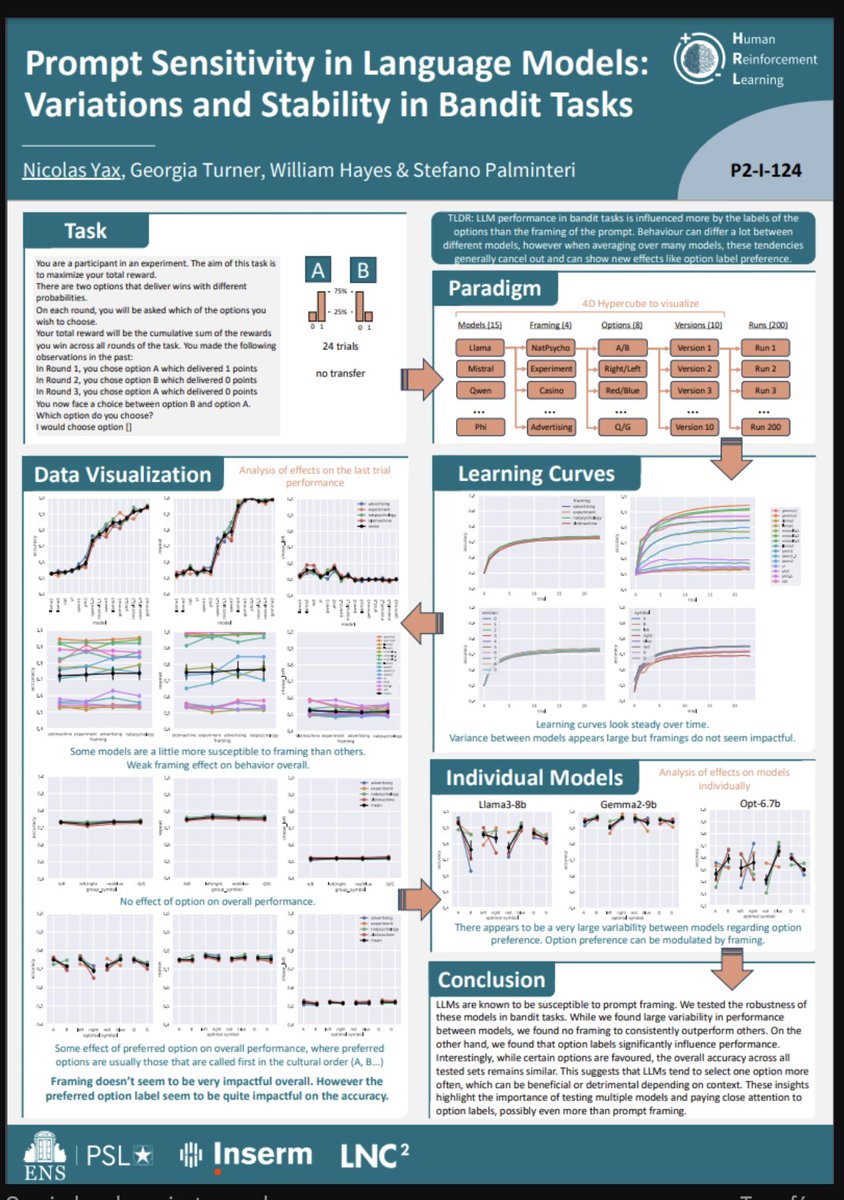
<a href="/nicolas__yax/">Nicolas Yax</a> will present "Prompt Sensitivity in Language Models: Variations and Stability in Bandit Tasks"  (machine behavior 🤖)

joint with <a href="/wmhayes_psyc/">William Hayes</a> &amp; <a href="/__GeorgiaTurner/">Georgia Turner</a> 

Saturday, Oct 12th, 2024 from 2:30pm-4:00pm
Darrell Worthy (@worthy_daw) 's Twitter Profile Photo

In a new paper out from our lab with first-author Mianzhi (Rudolf) Hu and Hilary Don, we present a model where uncertainty, modulates control of decision-responses between a Gaussian system that learns exact reward values, and a Dirichlet system that learns reward frequency.
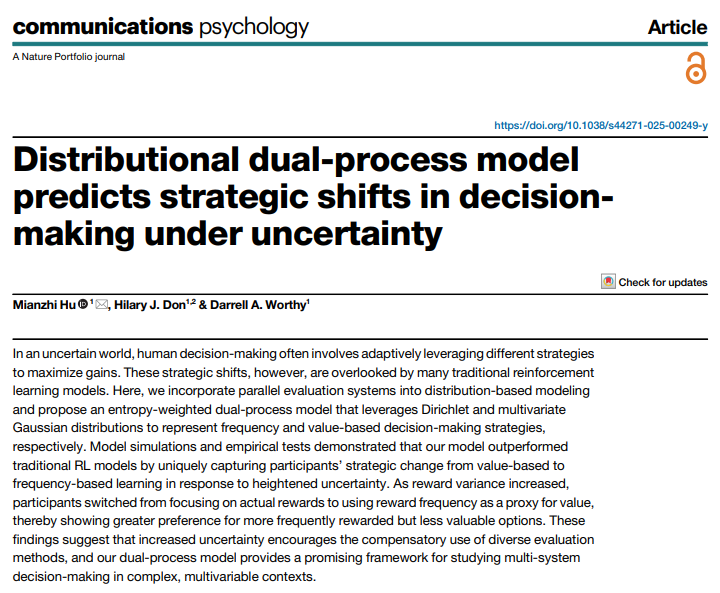
In a new paper out from our lab with first-author <a href="/HuMianzhi80965/">Mianzhi (Rudolf) Hu</a> and <a href="/hilaryjdon/">Hilary Don</a>, we present a model where uncertainty, modulates control of decision-responses between a Gaussian system that learns exact reward values, and a Dirichlet system that learns reward frequency.
William Hayes (@wmhayes_psyc) 's Twitter Profile Photo

In our latest preprint, we show how constraining a joint RL/sequential sampling model with eye-tracking data allows it to predict gaze biases in decisions from experience: biorxiv.org/content/10.110…